

The Brand Mention Workflow to fix what LLMs say about you
Audit how the web describes your brand and fix misaligned mentions that hurt your AI visibility.


Welcome back to The Workflow, the only place where no one will judge you if you call it GEO, AEO, flamingo, or AI search, as long as we can agree on one thing:
LLMs care less and less about what brands say about themselves. How others describe them carries way more weight.
Oh, the irony. Teams keep shipping fresh content on autopilot while the internet keeps repeating a brand narrative from three positioning pivots ago. This quietly kills online visibility because, unlike SEO, AI search gives you no noindex button.
Today’s guest is only in his mid-20s, but he understands how online search works better than most people ever will. Usman Akram, Discoverability Lead at influencer marketing platform Modash, built a workflow to help brands take back control of their narrative in AI search. It audits how the internet understands your brand, highlights gaps against your intended positioning, and tells you exactly what to fix first.
Less “publish and pray.” More “make the web speak with your brand voice.”
Let’s get to work 👇🏼
✅ What you’ll learn
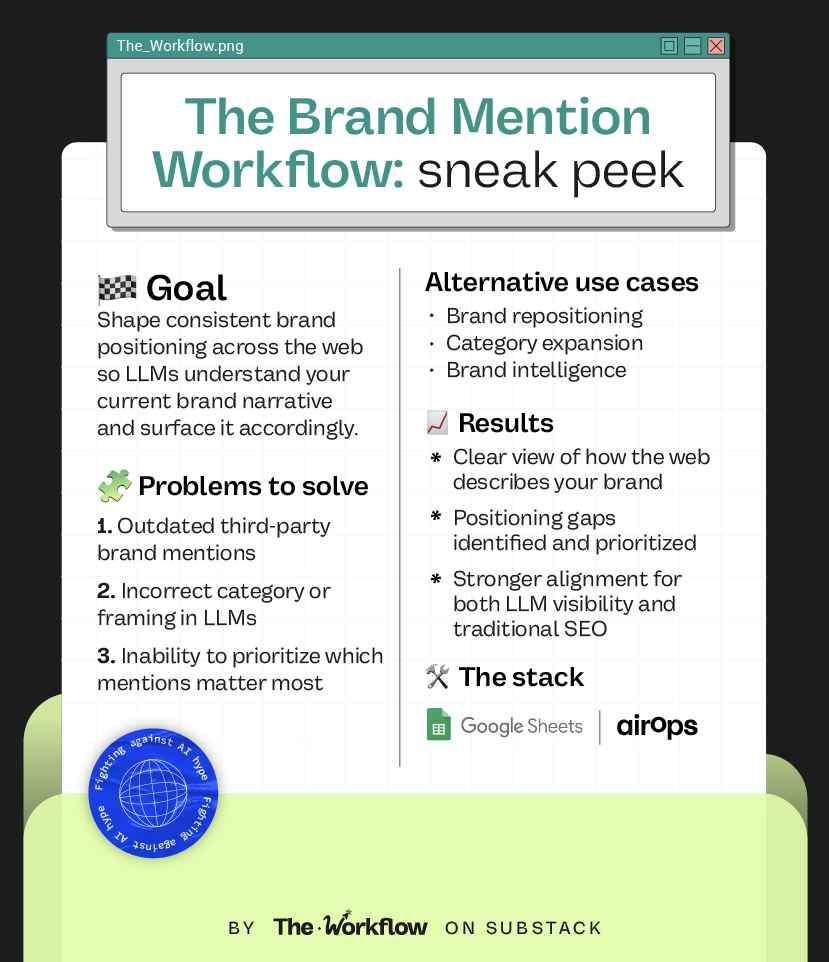
How to build an AI workflow to improve your brand positioning in AI search
How to find third-party brand mentions across the web and compare them with your intended positioning
How to prioritize which positioning mismatches to fix to improve your AI visibility
🧨 What triggered The Workflow
In a world where no one can say with 100% certainty how to show up in AI search (despite everyone having a hot take), Usman had a clear edge.
When he built this workflow, he was working at a well-known SEO agency in the middle of its shift into AEO. He was advising and managing dozens of client accounts, from fast-growing startups to brands with millions of existing mentions across the web.
That put him in a privileged position: deep SEO fundamentals, a ton of curiosity about how LLMs work, and enough real-world data to test his hypotheses instead of pontificating on LinkedIn.
One pattern kept showing up. Companies would evolve their positioning and expect a few fresh brand mentions to magically shape how AI talks about them.
“That’s when it clicked,” Usman told us. “LLMs care about recency, but they care even more about consensus. Adding X new mentions a month doesn’t change anything if the rest of the internet already spreads a different story.”
That’s when he flipped the approach. “Dear brand, before creating anything new, what if you fixed what already exists? What if you identified where LLMs get your brand wrong and corrected the highest-impact mentions first?”
Now he had to build something to make that possible. But not a content engine as he’d use for traditional SEO.
More like a brand guardian.
🛠️ How to build The Workflow
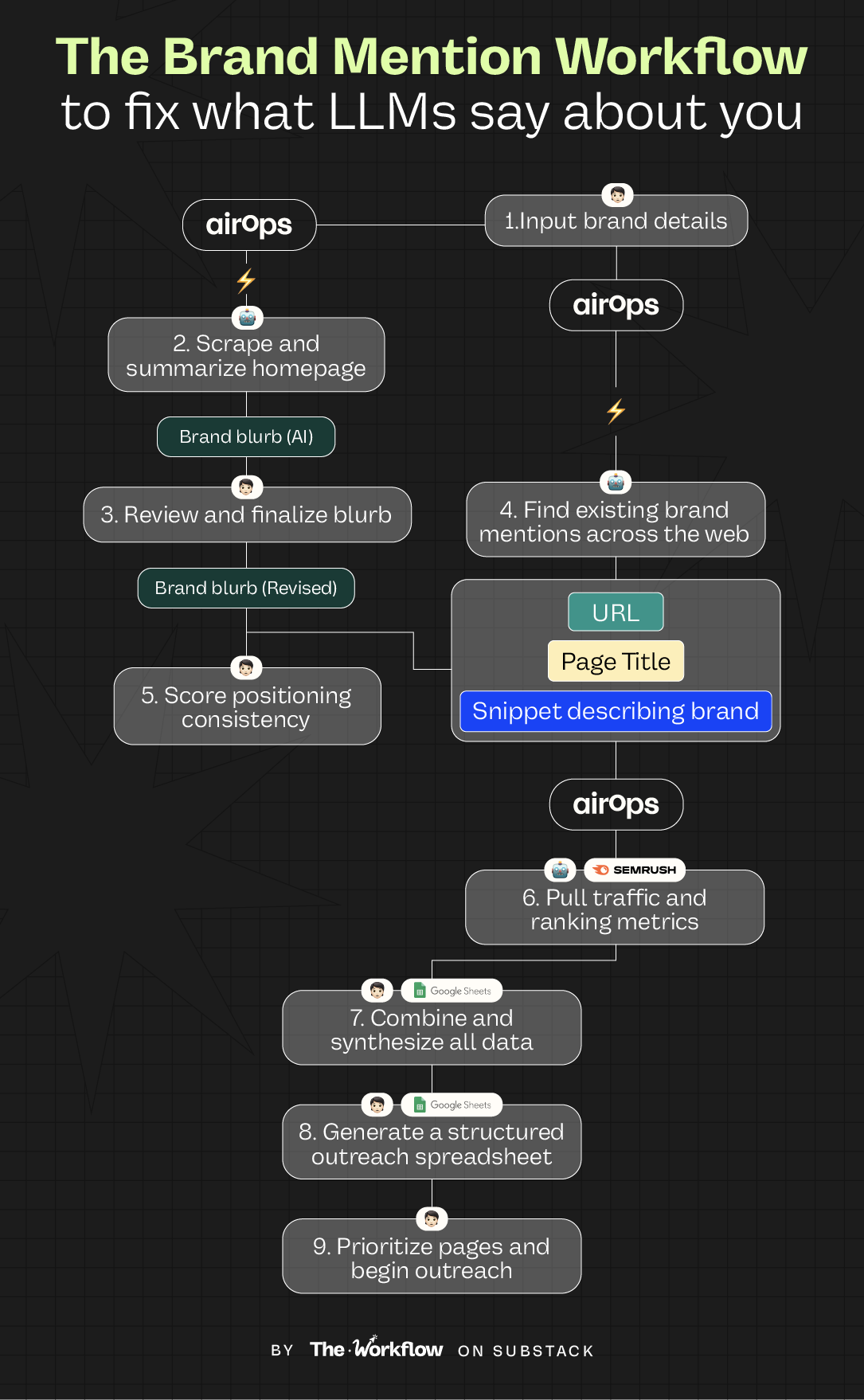
This workflow is essentially an internet-wide positioning audit. You feed it a brand name and a domain, and it will define
how you describe yourself today
scrape how the rest of the web describes you
surface where those two stories don’t match, and
tell you which mismatches you should fix ASAP.
In theory, you could stitch this together with n8n or any other workflow builder. In practice, Usman runs it in AirOps, which he half-jokingly describes as “n8n for SEOs.”
It’s built for people who understand the logic of automation but don’t want to wrestle with raw APIs all day. Native tool integrations remove much of the setup work, and for the more elaborate steps, Usman used AirOps’ copilot to generate code snippets without being a coder.
No panic, we’ll walk through each step. And yes, there will be prompts you can steal along the way, because we don’t do gatekeeping over here.
Step 1: Input brand details
The first AirOps step collects two inputs: the brand name and the primary domain you want to examine.
Domains alone aren’t super reliable input, so make sure to add the full brand name as well. Later steps will rely on exact string matching to find the right brand mentions across the web.
Once this step runs, both values are passed forward as variables to all subsequent steps and reused throughout the entire workflow.
Step 2: Scrape the homepage (brand positioning blurb)
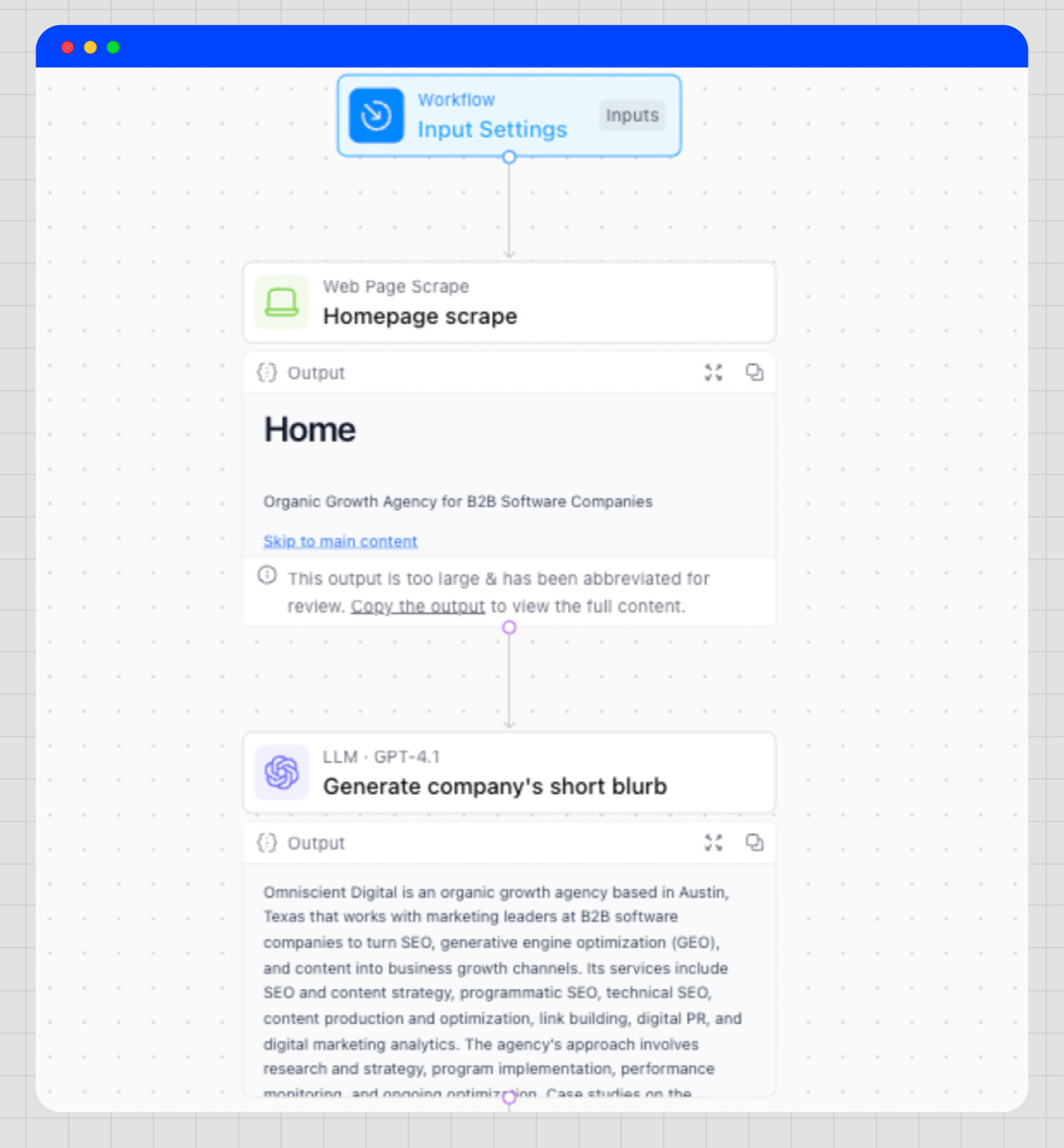
IMPORTANT: Make sure your homepage reflects the latest version of your company’s positioning. In this step, we scrape your homepage and pass the content to an AI step. The AI model (in this case ChatGPT 4.1) is instructed to produce a short, plain-language brand blurb that reflects how the company currently describes itself.
At this stage, the output is only a draft. The goal is to answer, as accurately as possible: “Based on this homepage, how would you describe this brand today?”
Before moving on, remember to proofread and edit the blurb if needed. Once it’s final, this version becomes the reference point for all later comparisons, so it should reflect the best version of your brand positioning.
👉🏼 Get the prompt to generate the brand positioning blurb here
Step 3: Find existing brand mentions across the web
With the positioning baseline locked, the workflow moves into discovery.
Using the brand name from Step 1, AirOps searches the web for third-party pages that mention it. For each result, it captures the URL, page title, and the snippet describing the brand. At this point, you will receive a list of websites that mention your brand.
Don’t worry about pulling too many results here. This step is meant to be broad, and we’ll prioritize what matters later.
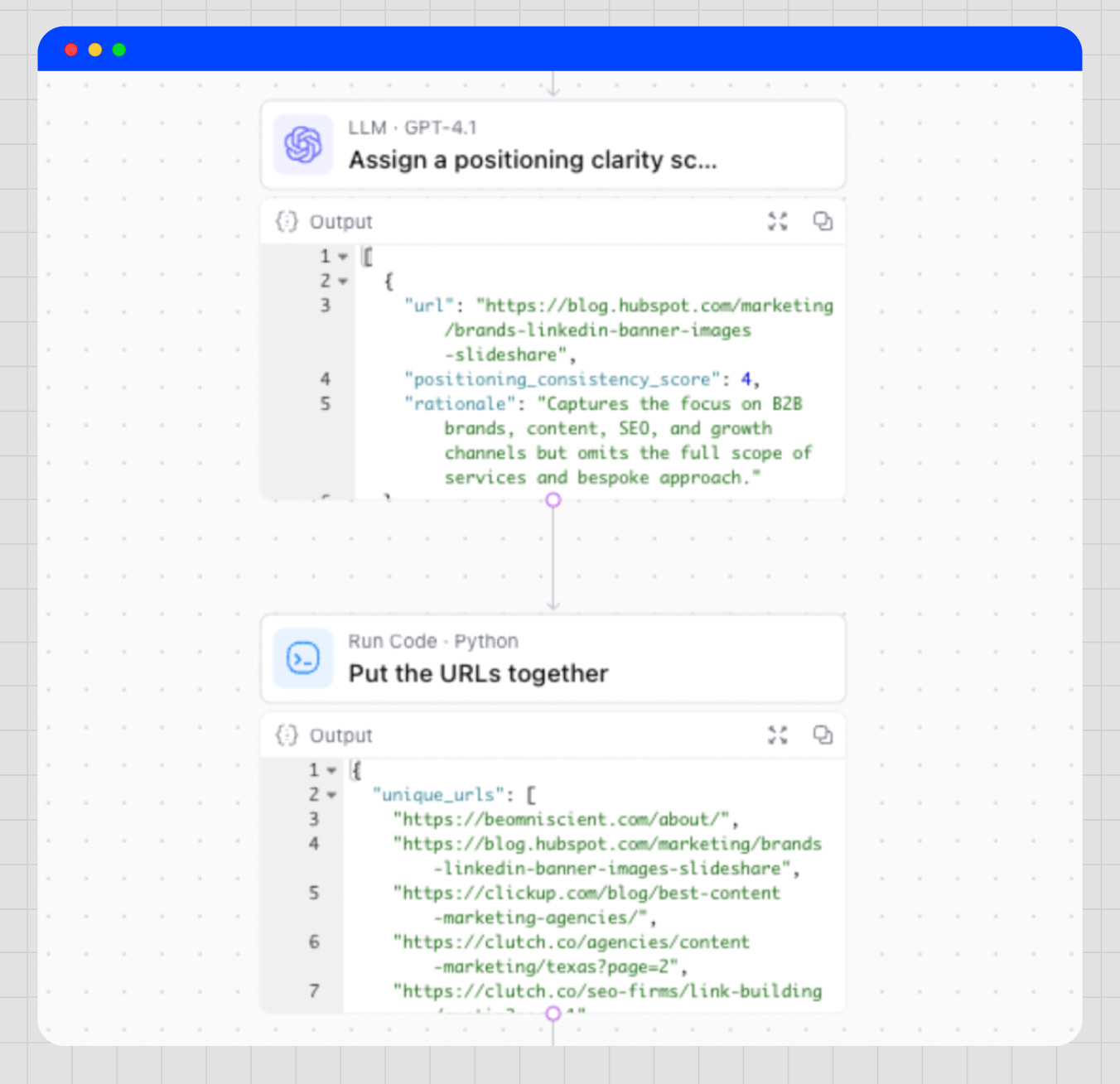
Step 4: Score positioning consistency
For each brand mention found in the previous step, an AI Step compares the third-party snippet to your approved brand positioning blurb. The output is a positioning consistency score from 0 to 5, where a higher score means the page description and the brand blurb are fully aligned.
Remember: this isn’t sentiment analysis. A source can praise the brand and still get a low score if it frames the brand in the wrong category, uses outdated language, or surfaces old positioning.
At the end of this step, every mention has a clear signal attached to it: how closely it matches your current positioning.
Step 5: Enrich mentions with traffic and ranking data
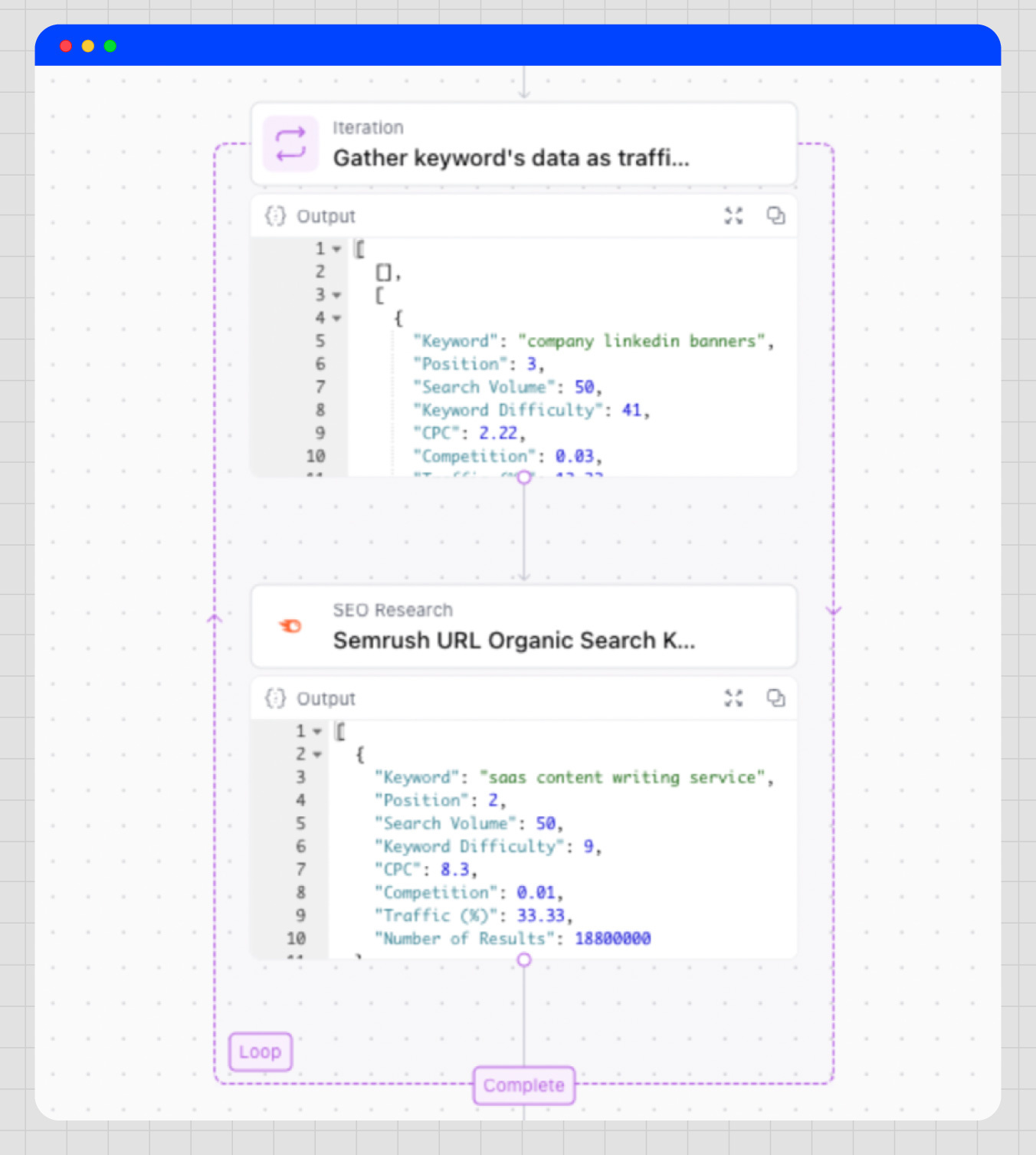
Once each mention has a consistency score, the workflow adds context.
For every URL, it pulls keyword rankings and search volume using Semrush data, which is natively integrated into this AirOps step. This is a proxy for traffic potential and shows which third-party mentions matter the most for users, AI search and traditional SEO. By the end, each mention is weighted by how visible it is.
A misaligned mention on a high-traffic page is a much bigger problem (and a much bigger opportunity to fix) than a perfect mention no one will ever see.
Step 6: Combine and synthesize all data
Now you have it all. Brand mentions. Positioning scores. Traffic potential.
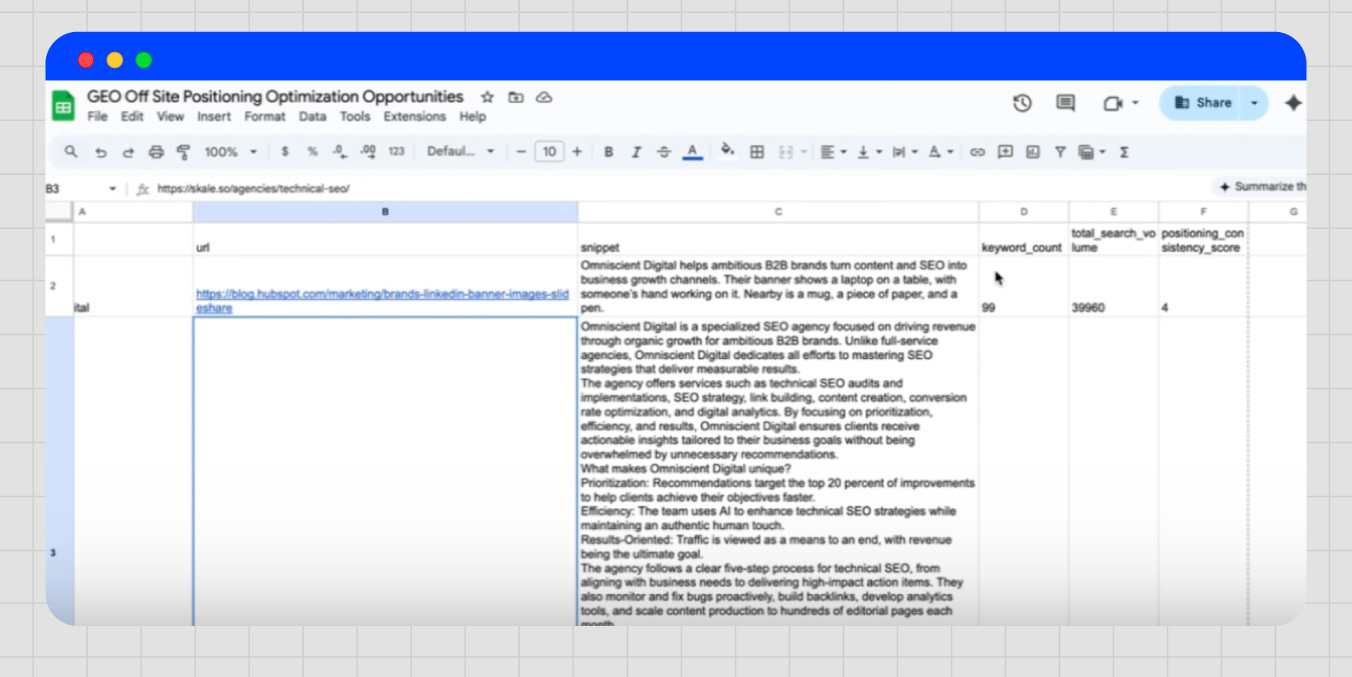
Time to connect all the dots. Using a lightweight aggregation step, the workflow merges URLs, snippets, consistency scores, and Semrush-derived metrics into a single dataset in Google Sheets. Each row represents one third-party mention, fully enriched and ready to be evaluated side by side.
This picture is clear. You can finally see which mentions are misaligned and influential, and which ones are misaligned but irrelevant.
From here on, it’s time to act on what will actually move the needle for your online visibility.
Step 7: Prioritize pages and start outreach
Use that juicy Google Sheet to sort brand mentions by positioning misalignment and traffic potential to see which pages are actively shaping how LLMs understand your brand.
Organize outreach starting with high-impact pages. Ask publishers, directories, and listicle owners to update how they describe your brand so the web starts telling the right story about you.
In case you forgot… 🤖 Get the prompts here
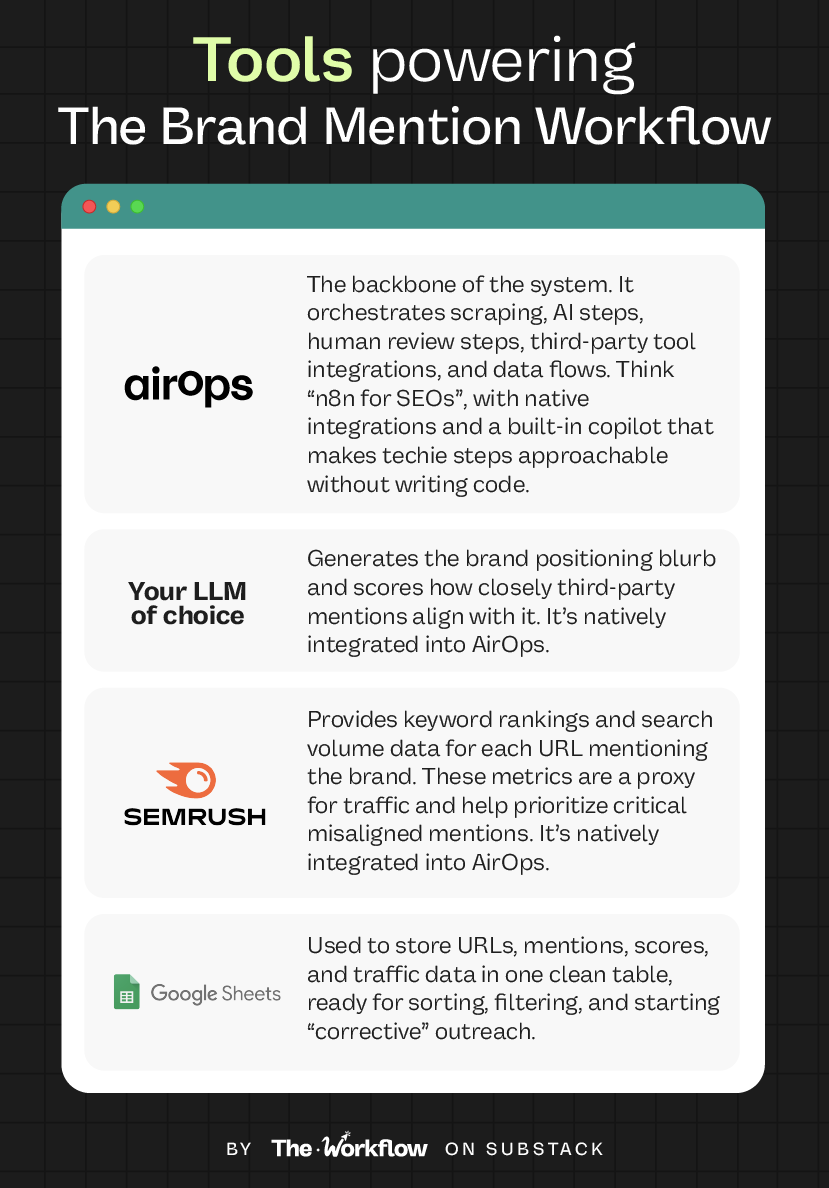
🤖 Tools powering the Workflow
AirOps is the only tool you need to replicate this workflow. If you’d rather build your own adventure with n8n or another workflow builder, you can stitch SEO tools and AI models together yourself.
🎢 Highs, lows and Workflow warnings
✅ What shines
It makes AI visibility measurable
With this workflow, you can see exactly how the web describes your brand today, where that description is wrong, and what pages influence how you show up in AI search.
It prioritizes impact, not busywork
Not all brand mentions are created equal. By layering positioning consistency with traffic data, the workflow tells you what fixes will move the needle, instead of sending you on a never-ending outreach scavenger hunt.
Human in the loop where it matters
AI does the crawling, comparing, and scoring. Humans decide what “correct positioning” looks like and which changes are worth pursuing. That balance keeps the workflow useful instead of creating a to-do list for the sake of it.
❌ What doesn’t shine
Large brands need tighter guardrails
If your brand has thousands or millions of mentions across the web, the mention discovery step can surface outdated or low-quality pages. Traffic filters help, but additional manual qualification is still required.
Outreach is still…outreach
The workflow gets you to a clean, prioritized list. Getting people to change copy still involves emails, follow-ups, and some luck. Sadly, the workflow can’t hypnotize the internet (yet).
⚠️ Workflow warning
If your positioning blurb is vague, your scores will be vague. If your discovery step is too loose, you’ll get noise. And if you don’t sanity-check the output, you’ll prioritize the wrong pages with great confidence.
This workflow shines when you’re precise about how you define your positioning and disciplined about what you act on.
✨ The Goldflow
Usman is unapologetically bullish on AI because “It makes work possible that simply would not happen otherwise.”
This workflow is a prime example of that shift. Without AI and automation, attempting it would have been *bonkers* at best. As Usman explained, “Anything that can be delegated can usually be automated to some extent. Not fully and not blindly, but enough to meaningfully change how we spend time and attention.”
Fully automated systems often create false confidence, where neat scores and clean outputs push teams to act on the wrong things.
The sweet spot is automating just enough that good strategy becomes unavoidable.
So yeah, AI won’t replace you, but it’s making the internet’s opinion about your brand impossible to ignore.
See you in two weeks with another workflow that exposes poor strategy, whether you’re ready or not.
Sara Stella & Diandra ✌🏼
Can’t survive two weeks without us? Catch up on past Workflows and steal the playbooks you missed.
🔥 The AI Website Audit Workflow roasting homepages in minutes
📚 The Marketing Report Workflow to slash production time by 50%
💡 The LinkedIn Content Workflow for scaling thought leadership
🔧 Help us fix more confused brand narratives!
🌯 It’s a major wrap
This was the eleventh edition of The Workflow, a bi-weekly newsletter by Sara Lattanzio & Diandra Escobar, where we unpack the playbooks that actually move the needle for marketers smarter than their tools.