
The AI Workflow scaling evergreen content at Search Engine Land
Find out how this 15-year-old SEO publication cut content production time from four weeks to one by rethinking how humans and AI work together
Welcome back to The Workflow, the newsletter that keeps poking at the messy intersection of humans, AI, and marketing (and everything in between).
A few months ago, Search Engine Land (SEL) did something most publishers and creators avoid: they told the world they were using AI to write a section of their content…and the internet exploded.
Some accused them of killing journalism, others of secretly training models on contributors’ content. A few applauded the transparency.
Behind the storm was an editorial experiment led by Kyle Morley, our guest today. He heads Acquisitions at Semrush and Sales and Marketing at Third Door Media, the publisher of SEL and MarTech (both now part of Semrush. Yes, it’s all connected!).
Their goal was to test how far AI could go in speeding up the production of their evergreen content section without sacrificing the quality and tone their readers love.
To solve that challenge, they built Harmony, a hybrid workflow where AI drafts and humans refine, cutting production time from weeks to days.
This issue gives you a rare look at how a global brand scales content with AI and the bigger questions that come with it.
How much should you scale?
How do you keep quality intact?
How do you communicate AI usage transparently?
How should you adjust your current content ops and team?
…and many more.
✅ What you’ll learn
What an AI-assisted editorial process really looks like inside a top publication
How humans and AI share the work across the content pipeline
SEO writing guidelines that will help you nail that first draft with AI

🧨 What triggered The Workflow
SEL has been publishing trusted SEO and PPC insights since 2006. They cover daily industry news and analysis, trends, expert columns, and the in-depth evergreen guides marketers keep bookmarked for years.
That scope is both a blessing and a curse.
News needs constant coverage and sharp opinions, not something you hand over to AI.
Meanwhile, each long-form guide took three to four weeks to go from outline to publish, bouncing between strategists, writers, and editors. With more than 1M marketers reading every month, the team couldn’t keep up with demand.
Kyle and his team were facing a tricky crossroads.
On one hand, hiring more writers would have boosted output but risked undermining consistency in tone, structure, and quality. Each new writer meant more rounds of edits and reviews, stretching an already slow four-week cycle even further. Instead of solving the problem, scaling the writing team would have only scaled the bottleneck.
On the other hand, keeping the status quo wasn’t an option. Demand for evergreen SEO guides was growing faster than their ability to produce them.
So they turned to AI to solve the dilemma. Instead of expanding the writing pool, they re-engineered the process around editors, the subject-matter experts closest to the audience.
For this type of evergreen content, AI proved surprisingly good at research and first drafts, while editors keep full control over structure and accuracy, adding the expertise and perspective robots can’t fake. The result is the hybrid workflow we’re unpacking today: part curation, part original insight, without reinventing the wheel each time.
And here’s the part we truly love: the efficiency gains went straight back to the humans. Cutting back on external writers freed up budget to increase editors’ salaries, hire real experts, and turn great writers into even better editors.
🛠️ How to build The Workflow
Full disclosure: Harmony is a custom setup built with the help of Christopher J. DiMarco, the automation wizard who stitched together their stack and content process through n8n. This machine is complex, but there’s plenty to take away about the perfect pairing of human expertise and AI scale.
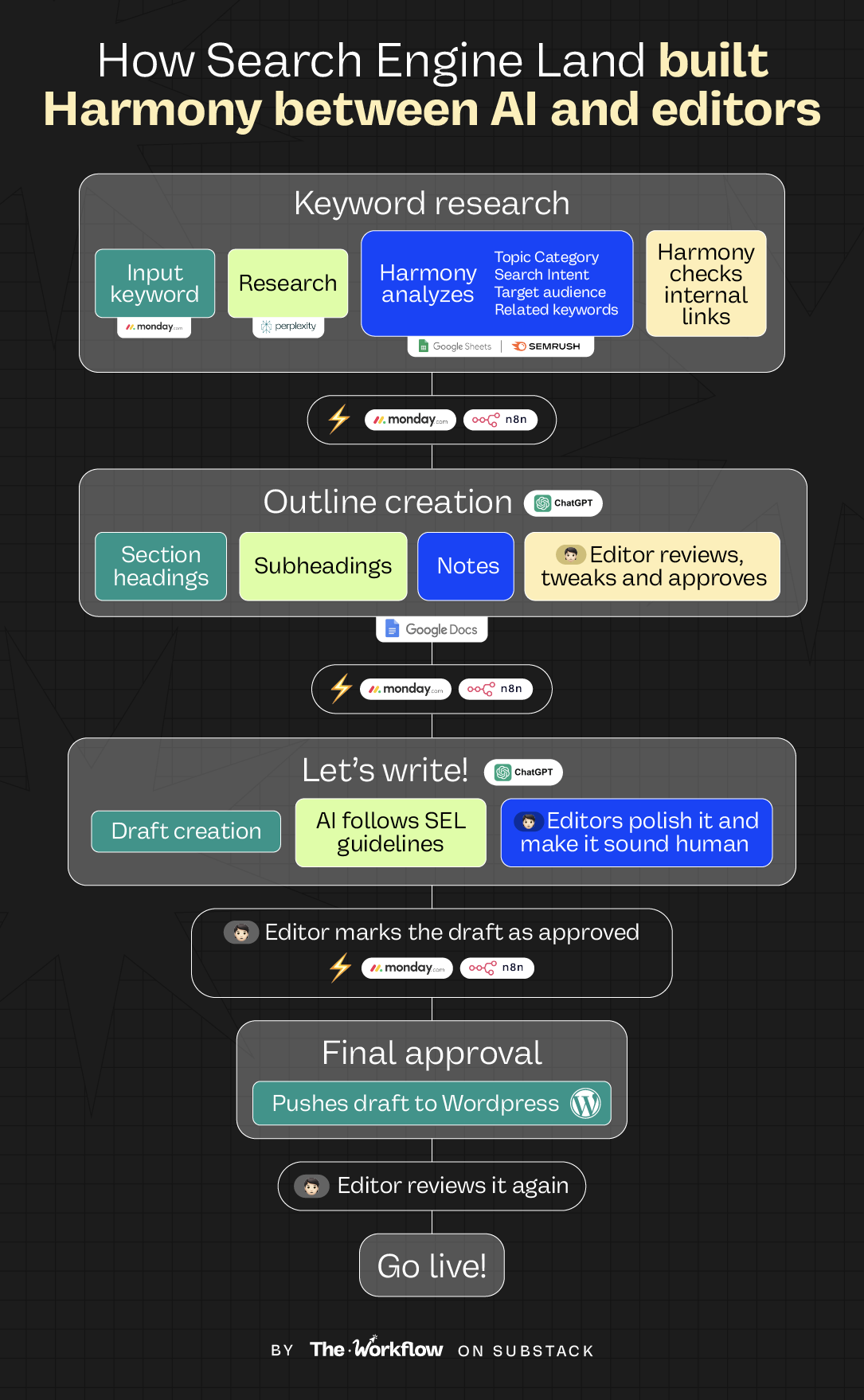
The workflow starts with entering a target keyword in a monday.com form and ends with a 5,000+ word evergreen guide ready to publish (and to rank).
We’ll also share the SEO Content Writing Guidelines that Kyle’s team baked into the system, so you can tweak them and run.
Let’s break it down.
Prep: Setup and guardrails
Building a workflow in n8n is the easy part. The hard part is having a well-oiled content engine worth scaling.
Kyle and his team at SEL had 15+ years of high-quality content to lean on, but the AI was trained only on the new guide content format launched in late 2024, paired with detailed editorial guidelines built exclusively for that purpose.
They also drew a hard line: not all content should be touched by AI. Harmony was designed only for evergreen, educational, SEO-focused guides with a fixed structure and strong research base, while news and thought leadership remain fully written by humans.
Each guide still touches five people: a content strategist, an editor, a senior editor, a project manager, and a designer. The bottleneck wasn’t the writing, it was the waiting. Drafts bounced back and forth for weeks, collecting dust between revisions.
With such a clear process in place, this was the perfect use case to let AI do more of the good work.
Step 1. Keyword research
The magic starts with one keyword.
The content strategist drops it into a simple monday.com form, which triggers automated research. Using Perplexity and Semrush data, Harmony analyzes input keywords to identify topic category, search intent, target audience, and related keywords, then logs everything in a Google Sheet for tracking.
Behind the scenes, Harmony also checks for internal links across SEL and MarTech to avoid content cannibalization. Once the research gets a human thumbs-up, the automation creates a monday.com task and moves the piece to the next stage: creating a killer outline.
Step 2. Outline creation
The outline generated by the system includes section headings, subheadings, and notes on what each part should cover. The goal is to give editors and strategists a clear blueprint before any writing begins.
The outline is stored in Google Docs and automatically linked to monday.com, where the task status updates to “Outline ready.” From there, the editor reviews, tweaks, or requests changes before marking it as approved, which automatically moves it to the next stage: writing the first draft.
Step 3: Let’s write! 📝
Once the outline is approved, Harmony hands things over to ChatGPT, which turns it into a full draft. Each section expands into clear, structured paragraphs, automatically formatted in Google Docs and linked back to monday.com for review. Every status change sparks the next AI workflow, completing the piece without anyone (but AI) lifting a finger.
But here’s where the real magic happens. The AI writes using SEL’s Content Writing Guidelines, following the same principles as their editors: chunkable paragraphs, set structure, and a conversational “coffee with an SEO pro” tone.
Editors then jump in to sharpen facts, inject their expertise, and ensure it sounds…human.
If a section needs more work, they simply flip the status to “Rewrite”, and Harmony runs another AI pass with the new edits.
😎 Grab the exact writing guidelines Kyle’s team uses to create high-quality blog drafts with AI
Step 4: Final approval & go live
When the editor marks a draft as “Approved” in monday.com, Harmony automatically moves it to the final review stage. The senior editor does one last pass for accuracy, consistency, and formatting before it goes live.
Finally, the system pushes the draft to WordPress as a preview post and updates the monday.com board. From there, hitting publish ismanual by choice. It’s the team’s final human checkpoint before content reaches SEL’s 1M+ readers.
🤖 Tools powering the Workflow
Despite its complexity, this workflow is built on a simple idea: let every tool and every human do what they do best.
Everything runs through n8n on the back end and monday.com on the front end, where each status change automatically triggers the next AI workflow. Research, outline, draft, and rewrite move seamlessly without manual handoffs. Editors keep full control of the process, stepping in to course-correct the AI’s work when needed.
🎢 Highs, lows and Workflow warnings
In a workflow where humans and AI finally coexist peacefully, something is still bound to go wrong. Harmony sounds…ehm…runs beautifully most days, but it still hits a few sour notes here and there.
✅ What shines
Human control at the speed of AI
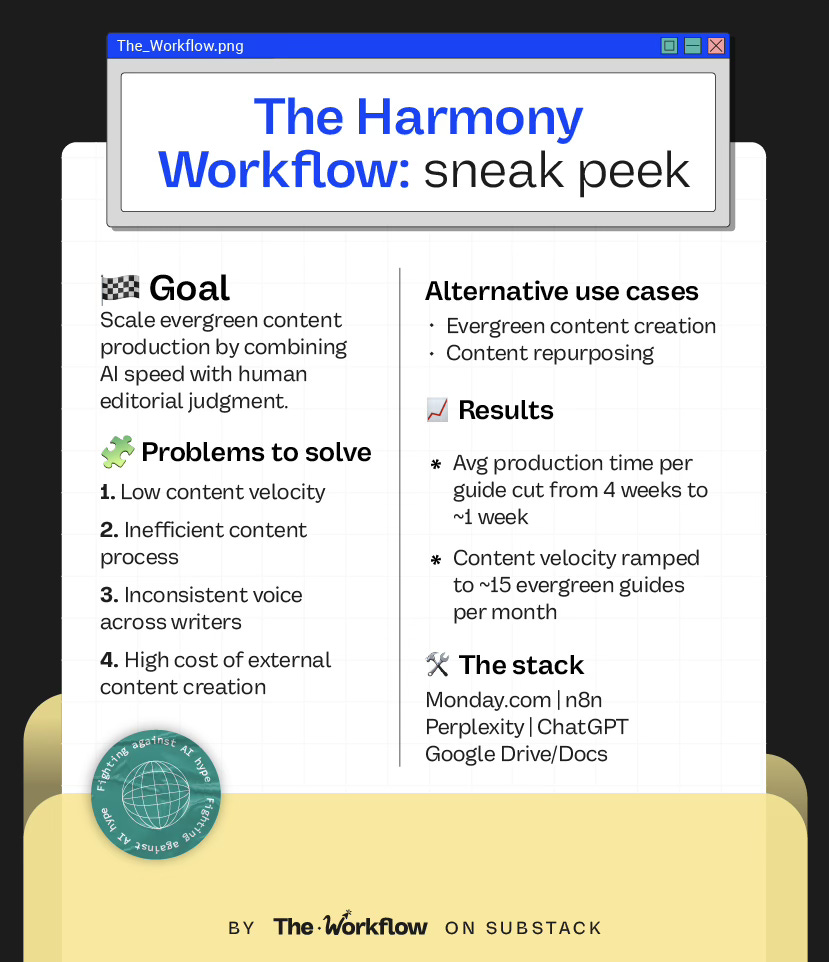
Production time dropped from 4 weeks to about 1 week without sacrificing content quality and consistency. “It still takes several hours of intense editing, but an editor could produce search-optimized 5,000+-word guides in a single day if they wanted to.”, Kyle told us.
Doubling down on human expertise
Another important side effect of the workflow is how it reshaped the team composition. Many former writers now work as editors, refining AI drafts instead of starting from scratch. As AI gets better at first-draft writing, human judgment, expertise, and tone matter even more. “We’re saving money overall, but now editors on our team are better compensated than they ever were before. The pie is now distributed differently.”
Sweet spot between automation and human oversight
AI handles research, outlines, and first drafts. Editors review, refine, and add expertise where it matters most. Every step still requires a human greenlight, ensuring quality never falls out of the loop.
❌ What doesn’t shine
Complex setup and maintenance
It takes solid technical know-how to build and maintain Harmony, and one small error in n8n can disrupt the entire editorial pipeline. This is an advanced system built for companies operating at publisher-level content velocity.
Not for every content type
This workflow shines when the rules are clear and (most) facts already exist. It’s perfect for SEO guides and educational pieces built on solid research, but not for news or thought leadership that rely on originality, timing, and fresh ideas.
AI ethics & other minefields
When SEL revealed it was using AI to write part of its content, the conversation heated up fast. Some readers assumed the models were trained on contributor work without consent. It wasn’t true, but it proved how sensitive AI ethics are and how crucial transparent, precise communication really is.
⚠️ Workflow warning
Harmony helped the team reach new heights in content marketing. The next step is not to stop, it is to calibrate. “We’ve covered the majority of the topics we wanted to cover. We’ll slow the pace a bit soon.” Finding the right scale is just as important as finding the right workflow.
✨ The Goldflow
“This project reaffirmed the importance of humans in the loop and made us feel less scared about what AI is doing to our industry. We gave it so much direction, so many steps to get to that first draft, and it still isn’t good enough until people touch it.”
AI may write the words, but humans give them meaning. Even advanced workflows like Harmony aren’t built to replace people, but to prove that the future of marketing is built when humans and AI work together… In harmony.
What’s your plan for Thursday in two weeks? Right, coming back here to steal our next workflow.
Sara Stella & Diandra ✌🏼
✍🏼 Let’s remind the world that AI can write content, but only humans make it worth reading.
🌯 It’s a major wrap
This was the ninth edition of The Workflow, a bi-weekly newsletter by Sara Lattanzio & Diandra Escobar, where we unpack the playbooks that actually move the needle for marketers smarter than their tools.


