

The Claude Code Workflow that enforces your brand style guide
Turn your published articles into a living style guide and run eight parallel agents to enforce it at all times, automatically.


Welcome back to The Workflow, where we think AI hype is a new kind of yellow fever.
Unless you live under a rock, you must have seen the Claude Code posts. “Marketers who aren’t using this will be obsolete by Q3.” “I automated my whole life, and I’ve never felt more alive.” We figured we owed it to you to check what’s noise and what’s real.
So we called Tim Metz, Director of Marketing and Innovation at Animalz, one of the most respected B2B SaaS content marketing agencies in the space. Tim has a basic coding background and the specific kind of brain that, once it discovered Claude Code, immediately started automating everything in sight: content workflows, LinkedIn post generation, AEO audits, and yes, at some point, his own sleep tracking. The terminal is now his natural habitat.
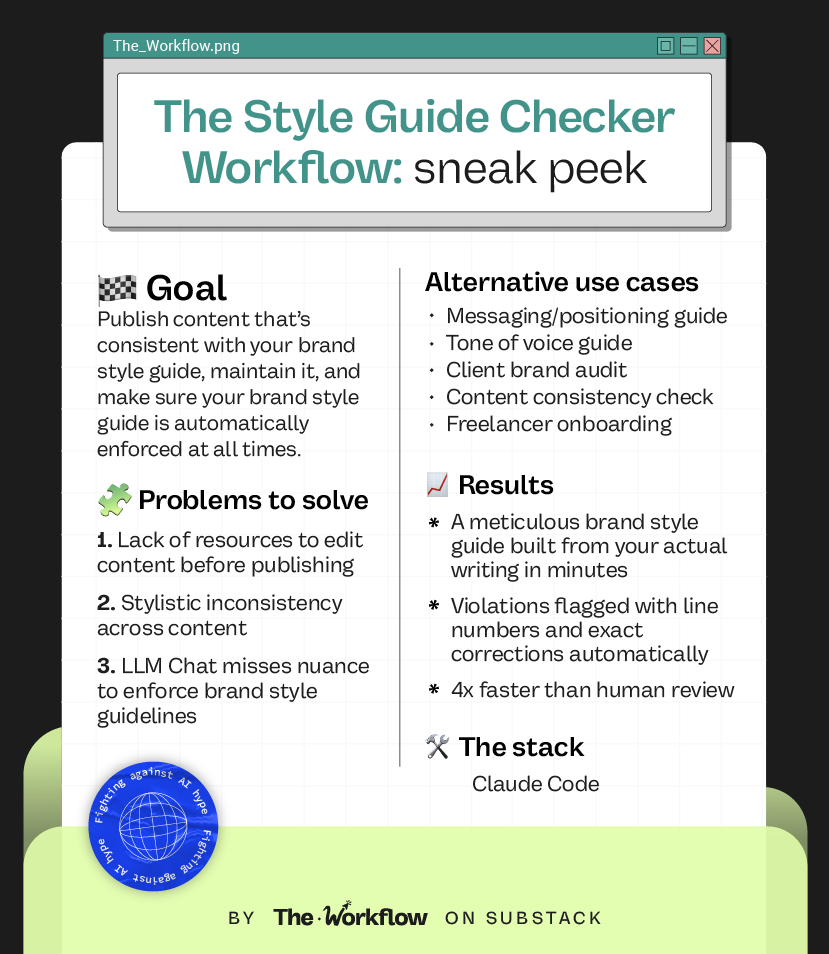
His workflow for this issue fixes a problem every content team has and rarely admits to: your brand style guide exists in a Notion doc, gets mentioned during onboarding, and enforces absolutely nothing in practice.
Tim’s Claude Code workflow reads your published articles, extracts your actual editorial patterns, turns them into a working brand style guide, and then runs eight parallel agents to check any new article against it, line by line. He built the whole thing in about 20 to 30 minutes, which means by the time you finish this issue, you could have one running too.
✅ What you’ll learn
What Claude Code actually is and how it works
How to generate a brand style guide from your existing published content, without manual work
How to run eight parallel AI agents to copy-edit any article against your brand style guide
How to set up Claude Code even if the word “terminal” makes you cry
🧨 What triggered The Workflow
At Animalz, content goes through a meticulous editorial process: writer to editor to copy editor, with each step significantly impacting quality and stylistic nuance. For the agency’s own marketing, the same rules apply… in theory. Client work always takes front row, and Tim runs internal marketing largely solo, which means when a newsletter issue goes out on a Thursday and a blog post needs to be ready by “yesterday”, his editor is often staffed on external projects.
“Unfortunately, it’s happened that I published an article on the Animalz blog without spending enough time on the style editing review,” he told us. Anyone who has ever been a team of one knows exactly how that happens.
The second problem: because some articles skipped the process, the brand style guide had drifted. Certain rules were respected in some articles, but ignored in others. Nobody had a reliable picture of what the actual house style even was anymore. Brand style guide maintenance is the kind of task that always gets added to the list but never makes it to the top.
Tim had tried solving the problem with AI before. ChatGPT, earlier Claude models, various prompting approaches. They would catch some things and miss others. Inconsistently. Unpredictably. The problem was much bigger than the model: one context window, one pass, too much context and too many assets to hold at once.
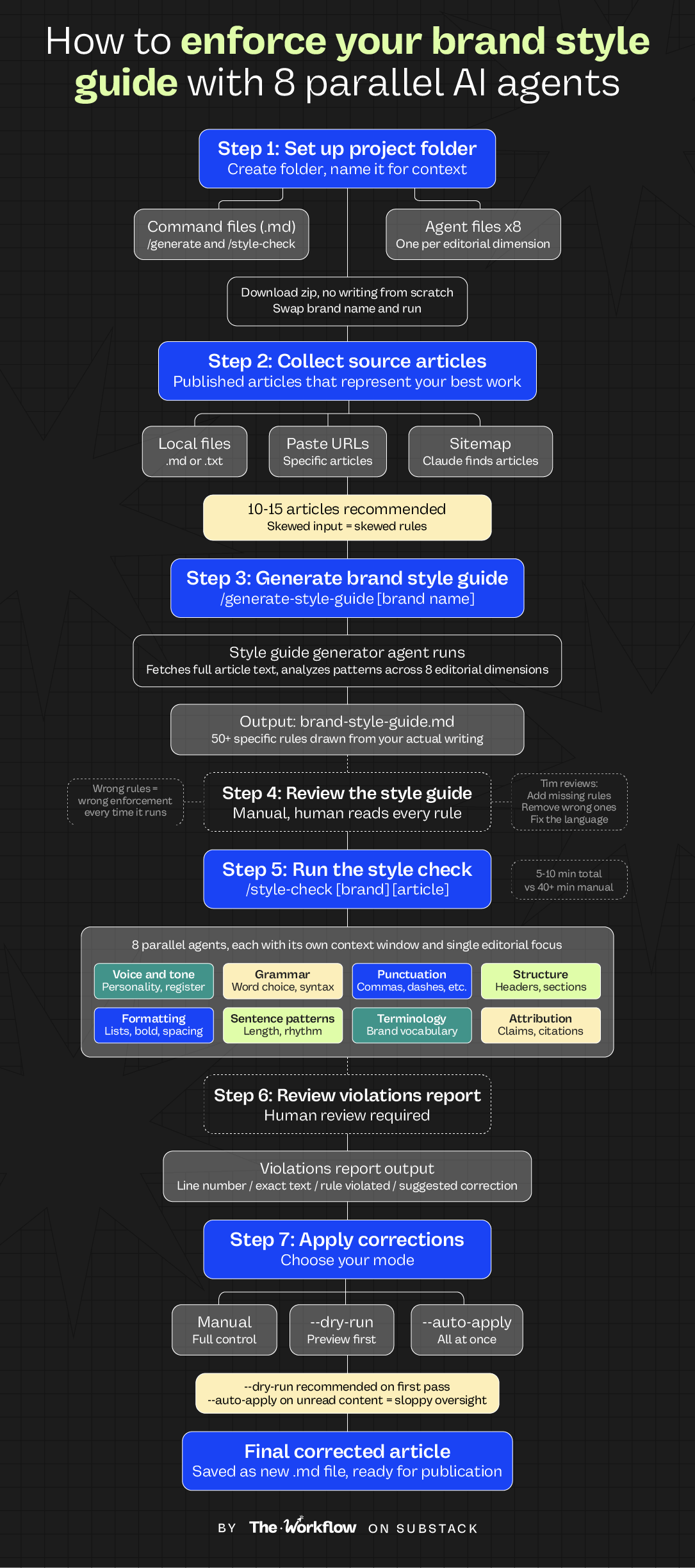
Claude Code changed the constraint. And that changed the game for internal marketing at Animalz.
🛠️ How to build The Workflow
 | A guest post by
|