
The Influencer Marketing Workflow to discover creators your audience loves
Find the best-fit influencers for your next product launch with this simple ChatGPT workflow that cuts research time in half.
Welcome back to The Workflow, the only newsletter that admits AI can be both a nightmare and a lifesaver, sometimes in the same day.
This week’s guest, Sarah Adam, Head of Influencer Marketing at Wix, spends her days building long-term partnerships with hundreds of creators across every social platform you can imagine. Which is why the rise of AI influencers and “AI twins” freaks her out (same for us, by the way). “It’s hard to relate to someone who’s made of pixels and looks like a model,” she told us. “Influence only works when it feels human.”
The workflow Sarah shares today is her quiet rebellion in the name of authenticity. It uses AI to find the right creators faster, not to replace them.
If influencer marketing has a place in your 2026 strategy, you’ll want to steal this one.
✅ What you’ll learn
How to use AI to speed up influencer discovery without killing authenticity
How to extract keywords for influencer discovery from product documentation
How to define ideal influencer profiles for several products and different ICPs
🧨 What triggered The Workflow
There’s no such thing as a one-size-fits-all influencer marketing approach at Wix. With several brands in their portfolio targeting very different user groups, each campaign needs its own formula. Some speak to professional designers building sites at scale with Wix Studio, others to individuals or small businesses building apps with Base 44, Wix’s recently acquired AI app builder for non-techies. The first group looks for depth, tutorials, and design inspiration. The second values snackable content, simplicity, and creators who show that tech can be accessible to anyone.
TLDR; Each audience needs its own story, tone, and influencer type to make the product click.
The prerequisite for winning influencer campaigns is crystal-clear product marketing. Sarah starts with a detailed deck outlining features, positioning, and target users. From there, she has three main jobs: defining influencer profiles that each audience will resonate with, finding those influencers, and making the deals happen.
To identify the right cleators, Sarah starts by clustering keywords related to the product and the audience’s topics of interest.
Before she created the Influencer discovery workflow, she had to chase the SEO team for help (spoiler: not their top priority) or spend hours buried in decks and demos, manually extracting keywords and hoping they might unlock the right creators.
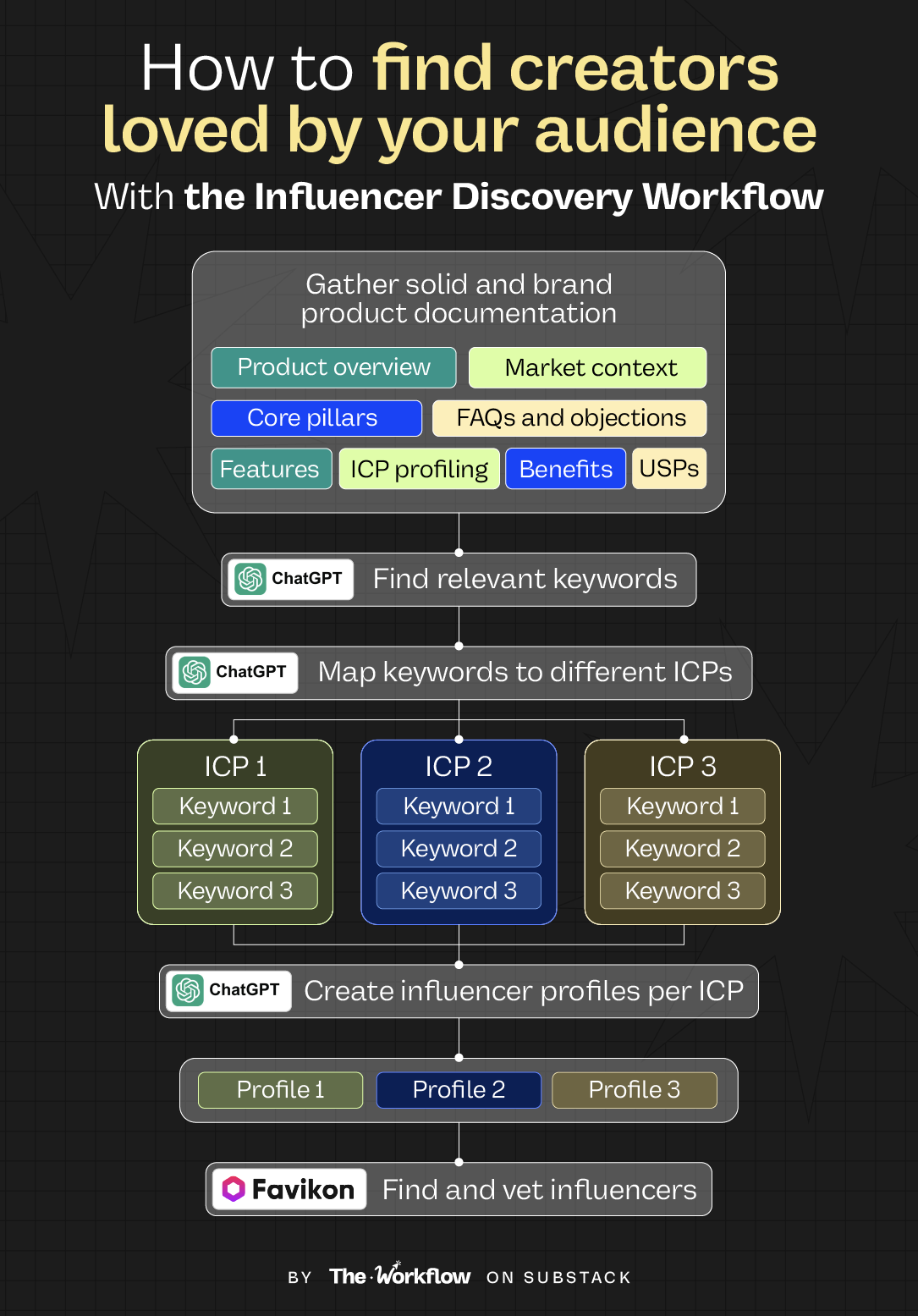
Today, she just drops the product marketing deck into ChatGPT and instantly builds hyper-relevant influencer profiles based on topical keyword clusters.
🤯
🛠️ How to build The Workflow
It all starts with the product marketing deck, the single source of truth that defines features, benefits, and ICPs. From there, the workflow runs through three simple prompts: one to extract keywords, one to map them to ICPs, and one to reverse-engineer influencer profiles for each audience.
Step 1: Gather solid product and brand documentation
This step decides how good your output will be, so don’t half-bake it. For Sarah, it starts with a 20-slide deck that spells out what the product is, who it’s for, and why anyone should care.
Strong product marketing documentation includes:
Product overview – what the product or feature is, what problem it solves, and why it matters. Includes taglines, one-liners, and a short narrative that explains the product in plain English.
Core pillars and features – the product’s main values or themes, mapped to the features that deliver them, plus short descriptions of what each feature does and the value it brings.
Benefits and USPs – the real outcomes for users, such as efficiency, productivity, or creativity.
Market context – competitive landscape, positioning statements, and key talking points often found in the press release.
FAQs and objections – common questions, hesitations, and how the product addresses them.
ICP profiling – who you’re targeting: roles, goals, pain points, and where they spend their time online.
That’s your product from A to Z, ready for ChatGPT ingestion.
👉🏼 Grab all the prompts you need to run this workflow before you end up keyword-hunting at midnight.
Step 2. Turn product documentation into relevant keywords
Time to turn that product deck into insights. Upload the documentation from Step 1 into ChatGPT and run the first prompt to extract and expand a list of keywords that describe the product, its features, and the topics your audience actually cares about.
According to the prompt, each output keyword will be short (a maximum of three words) and grouped by theme. These clusters will become the building blocks for your influencer search later.
Step 3: Map keywords to different ICPs
Now that you’ve got your keyword clusters, it’s time to give them direction. Use the second prompt to define your Ideal Customer Profiles (ICPs) based on the brand documentation and assign the right keyword groups to each one.
⚠️This step is especially powerful if you manage multiple products and ICPs, as it gives every campaign its own audience playbook and shared vocabulary.
Step 4: Create influencer profiles per ICP
With your ICPs defined and keyword clusters ready, it’s time to bring the humans back into the mix. Run the third prompt to generate ideal influencer profiles for each ICP. ChatGPT will combine the audience insights and keyword themes to describe the types of creators each buyer group actually trusts.
You’ll get scarily detailed influencer blueprints covering platform mix, content style, audience size, and tone. For example, one profile might describe a YouTube designer creating tutorial-style content, while another might highlight a TikTok creator focused on AI app hacks for beginners. Sometimes, ChatGPT will even estimate (fictional) posting cadence or content performance data for specific creator profiles.
🤳🏻 Now all you have to do is go find those creatures in their natural habitat: social media.
Step 5: Find and vet influencers
This is where AI hands the baton back to you. Use the keyword clusters from Step 2 to search for creators in your discovery tools or directly on social platforms. Sarah uses the influencer discovery platform Favikon, but you can also search manually. The difference is granularity (filters), time, and access to audience or performance insights.
Once you’ve pulled a list of potential matches, switch to the influencer ChatGPT-generated blueprints from Step 4 to validate them.
Ask yourself the following questions when evaluating influencers:
Do they match the tone, platform mix, and content style your ICP actually trusts?
Are they credible and consistent in what they post?
Would your audience actually listen to them?
Is their content and tone aligned with your brand?
Does their engagement look authentic?
The goal isn’t to find superstars with billions of followers. It’s to find people your ICP already trusts.
Finally, reach out and make the deal happen. AI gets you here, and the human touch takes you further.
🤖 Tools powering the Workflow
Sarah’s stack is the good kind of boring: zero automations, just a setup that gets the job done so she can focus on the tasks AI can’t replace. What truly matters to her is building long-lasting partnerships with creators who genuinely align with the brand and keep its story alive, campaign after campaign and launch after launch.
🎢 Highs, lows and Workflow warnings
Forget human-assisted AI. This is AI-assisted humans at their best. Sarah’s workflow is so dialed in that there’s barely anything to fix — maybe just a solid base to build on.
✅ What shines
Time halved, precision doubled
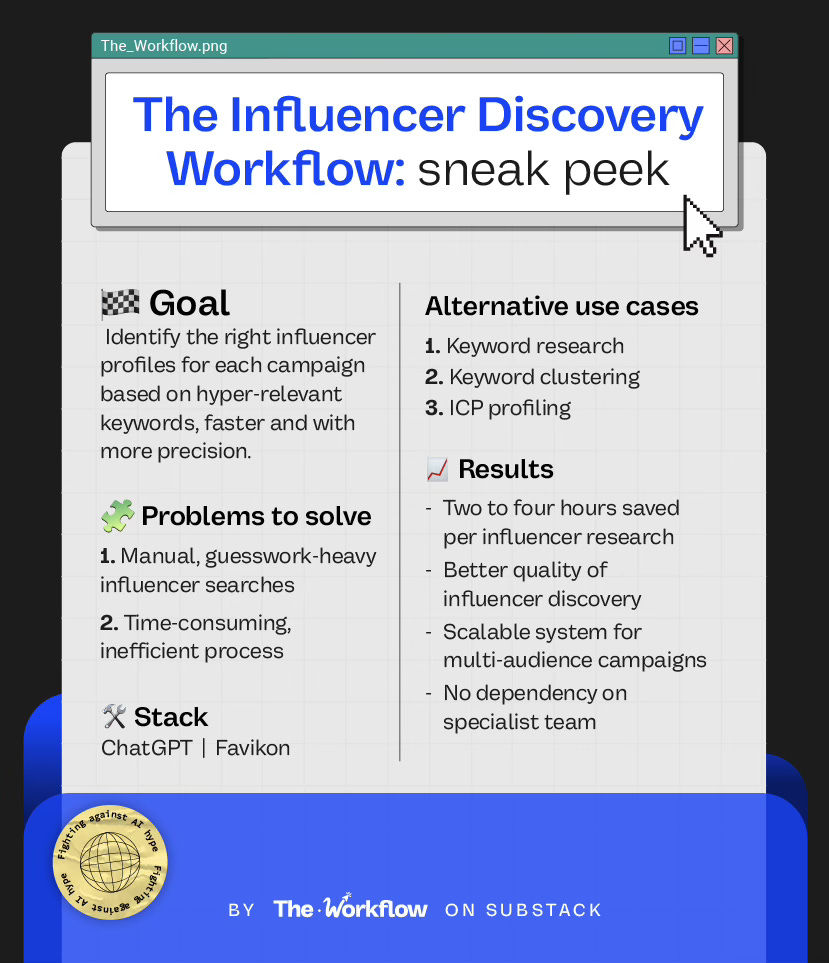
The workflow cuts out two to four hours of manual keyword hunting per campaign. “Now I just refine what AI gives me instead of spending an afternoon digging through product decks,” Sarah said.
It’s not just about time savings, though. “If I did it manually, I’d never be able to build such a comprehensive list of keywords,” she added. Even if she doesn’t use every keyword to hunt for influencers, the breadth gives her room to experiment, find fresh creators, and launch campaigns faster across product lines.
Clean handoff between human and AI
The workflow stops exactly where it should. AI lays the foundation, but Sarah and her team take over when real people enter the picture. From outreach and negotiation to briefing and approvals, she keeps every interaction personal. “I know it can be automated, but relationships with influencers are too important to us.” That’s the line she won’t cross.
❌ What doesn’t shine
Manual influencer review eats up tons of time
Even with AI handling the heavy lifting, Sarah still has to validate every creator profile manually. “I can’t just export influencer lists and fire emails. I have to go one by one, open each profile, and check their posts to see if they’re actually relevant.” Favikon’s filters help a lot, but sometimes creators show up in categories that aren’t their core focus. This is a slow, repetitive step she’d gladly hand over to AI, but it’s necessary to ensure every partnership truly fits.
⚠️ Workflow warning
Resist the hype to scale and automate everything. Just because you can, does it mean you should? When we asked Sarah if she’d ever considered automating parts of this workflow, like importing or exporting data from ChatGPT, her answer was simple: nah.
“I use it when I’m working on something brand new, which doesn’t happen every day. The research we do now will probably run for at least six months.” Hard to argue with that.
Still, a custom GPT would probably save her a couple minutes of prompt copy-pasting per quarter at the very least. 🙃
✨ The Goldflow
Working with AI reminds Sarah about what’s truly valuable in her day-to-day. The hours she spends messaging creators, negotiating, reviewing drafts, and giving feedback aren’t inefficiencies; they’re THE job. What AI took over were the prerequisites.
It’s the same tension every marketer faces today: deciding when to delegate to machines and when to protect the human touch intentionally. As Sarah said, half-joking (but not really), “If one day I email an influencer and an AI agent replies, that’s when I’ll quit and become a kindergarten teacher.”
…Assuming, of course, we’ll still be able to tell it’s an AI agent.
See you in two weeks,
Sara Stella & Diandra ✌🏼
🥊 Help us stop the rise of AI influencers with perfect teeth.
🌯 It’s a major wrap
This was The Workflow, a bi-weekly newsletter by Sara Stella Lattanzio & Diandra Escobar, featuring one real workflow that moved the needle for someone even smarter than the system they built.


