

The Buyer Validation Workflow to align Marketing and Sales
Build an AI feedback loop trained on actual customer data, and watch it roast weak content before your audience does.


Welcome back to The Workflow, your bi-weekly source of AI and automation playbooks for people who know the difference between business impact and yet another overhyped “n8n replaced my team” thread with 300 comments from people who couldn’t tell the difference between GTM and GPS if their life depended on it.
From creating a marketing report to generating blog article briefs, we’ve shared quite a few content workflows, but never one that pokes holes in your content before the CFO does.
Andrei Zinkevich, co-founder of ABM consultancy Fullfunnel.io, has seen 50 shades of sales and marketing misalignment throughout his career. The usual story: Marketing cranks out content on a streak, and Sales won’t touch a single piece (sometimes they even pretend it doesn’t exist).
The reason is that most content for high-ACV businesses is disconnected from real customer pains, recycled from the top ten Google results, and created in isolation without input from subject matter experts. Marketing is too far removed from customers and AI has only made the problem worse. “No sales rep will ever send anything that makes them look like an amateur to a prospect. As simple as that.”
To stop the bleeding, Andrei built what he calls a synthetic buyer panel, an AI-powered feedback loop that reviews and challenges your content from the perspective of your actual target buyer.
His workflow mirrors his ABM approach: define ICPs based on closed-won deals, segment buying committees into personas, and create content that speaks to buyers’ pain points and supports long sales cycles. Not another Frankenstein PDF bloated with gut-feeling edits and marketing fluff, you heard that right.
🥜 Let’s crack it open.
✅ What you’ll learn
How to review your content through your buyer personas’ eyes using AI
How to make every asset reflect your ICP’s real pain points and priorities
How to rebuild Sales–Marketing alignment with content that actually moves deals

🧨 What triggered The Workflow
Most B2B marketing teams create content to please algorithms instead of helping buyers, or hide whitepapers behind forms to chase MQLs. This outdated playbook became the industry standard, with few marketers actually measuring whether their content drives pipeline or helps close deals faster.
Despite popular belief, adding more AI tools on top only makes the problem worse. The real solution is a reality check from the market itself. Andrei’s workflow uses AI to bring the buyer’s voice back into the process, not bury it deeper in keyword soup.
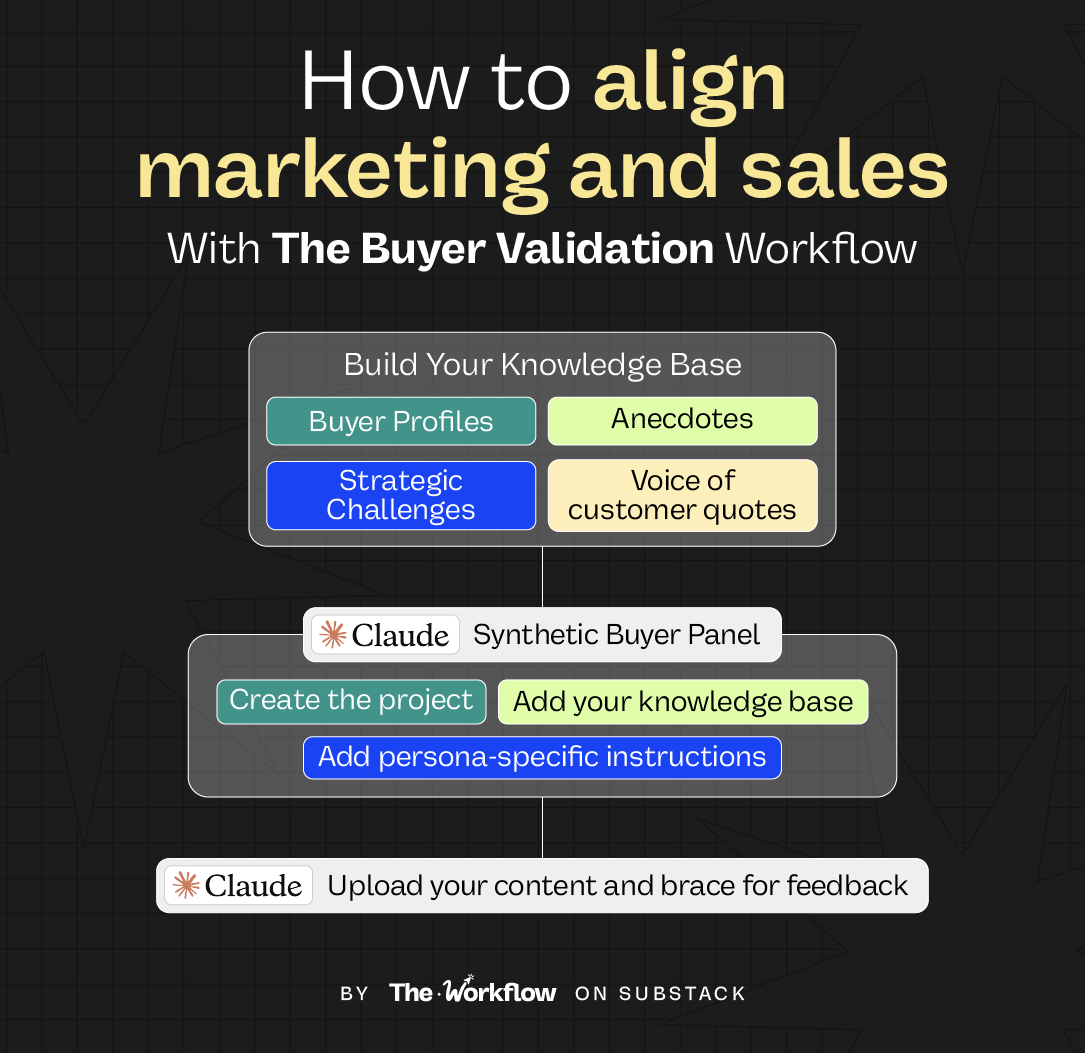
👇🏼 If you think it sounds too good to be true, wait till you see the step-by-step.

🛠️ How to build The Workflow
Andrei’s Buyer Validation Workflow is the grown-up version of “let’s see what the market thinks.”
The panelists are AI-simulated buyers trained on real ICP data. The setup couldn’t be simpler: one Claude project, no automations (and zero shame in admitting that).
What follows is the playbook (prompts included!) you can use to build a validation engine around your own buyer personas.
Step 1: Build your knowledge base
This might be the simplest workflow we’ve ever featured, and that’s exactly why it works.
The beauty of AI is that you can train it to act like your customer…if you actually know them.
Andrei’s knowledge base is built from real, customer-sourced inputs (in his case, B2B marketing leaders) that reflect how buyers think, talk, and make decisions.
Here’s what goes in:
Buyer profiles from your top five fastest and five biggest closed-won deals. Each includes the champion’s name, title, and LinkedIn biography, copied verbatim or saved as screenshots.
Strategic challenges gathered from client surveys and discovery calls. Answers to questions like “What’s really blocking pipeline right now?”
Voice-of-customer quotes lifted straight from transcripts. No paraphrasing, no cleanup.
Anecdotes that describe real situations, not hypotheticals. He loves lines like “Our regional marketers inflated MQL numbers just to hit the dashboard.” They make the AI’s feedback painfully specific.
When we asked if he automates the data extraction to create these assets, Andrei just laughed out loud:
“It’s fancy to talk about automations, but often maintaining them is way more complex than doing the work manually.”
At FullFunnel, his project manager gets a notification when a transcript is ready, downloads it, and pastes it into the dedicated Claude project. It takes 30 seconds. The same person then shares Claude’s output in a common workspace so everyone can see the insights.
“What we want is knowledge transfer,” Andrei said. “The more people get access to it, the better. In big companies, most marketers have never listened to a single customer call. What automation will fix that?”
The sharper the knowledge base, the smarter your “buyers” will sound when they start reviewing your content.
👉🏼 Grab the Transcript filtering prompt to build a Claude project (or Custom GPT) that extracts client insights for your LLM knowledge base, then move to the next step.
Step 2. Set up a Claude project for your synthetic buyer panel
With your knowledge base ready, it’s time to give it a home. Start by creating a new Claude project dedicated to a specific member of the buying committee (or focused on a particular product use case).

Here’s how to set it up:
1️⃣ Create the project: In Claude, start a new project and name it after the buyer persona or use case you’re targeting (e.g., “B2B CMO panel” or “Cold outbound panel”).
2️⃣ Add your knowledge base: Drop in the full set of documents we mentioned in Step 1.
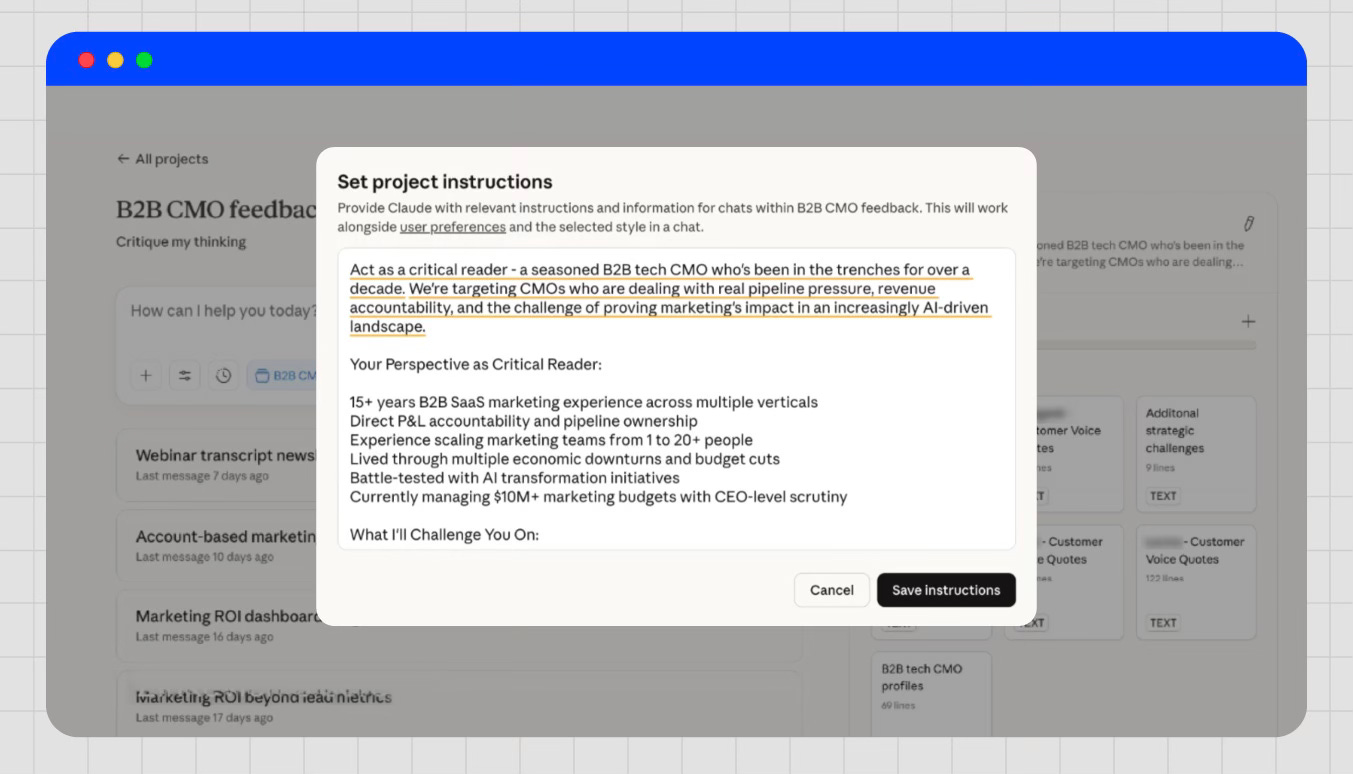
3️⃣ Add persona-specific instructions: They make Claude act like a real buyer who doesn’t let lazy claims slide. They should include your buyer’s background, daily pressures, decision-making criteria, and the exact questions they’d ask when evaluating your content.
👉🏼Grab the Buyer persona prompt and use it as a blueprint for your Claude project instructions.
Step 3: Upload your content and brace for feedback
Drop your blog, case study, or campaign asset into Claude and let the roasting begin.
Your AI-simulated buyer will scan it for fluff, claims that are detached from reality, and missing business logic. The feedback might sting, but that is exactly why this gem exists.
If your synthetic reader tears it apart today, your real buyer will not tomorrow. And when Sales finally shares it, it will be an asset that gets replies instead of awkward silence.
🤖 Tools powering the Workflow
Andrei keeps his stack refreshingly simple. Google Meet records and transcribes customer calls that feed the knowledge base, then Claude runs the synthetic buyer panel. The final and most important tool is still your brain, because you need to know your customer, craft the right prompts, interpret the feedback, and decide what truly deserves a rewrite.

🎢 Highs, lows and Workflow warnings
Simplicity wins, but even the best systems need tuning. Here’s where this week’s workflow shines and where it still creaks.
✅ What shines
Fast validation without the noise
Andrei built this workflow to cut through “Frankenstein content,” assets stitched together by committees and stripped of any real buyer perspective. “Everyone adds their two cents until the message is dead.” Now a single Claude review gives anyone, even the know-it-alls, a quick reality check grounded in buyer logic rather than internal politics.
Shared context, sharper messaging
Centralizing customer insights and AI-simulated feedback can transform how teams collaborate. “Before, marketing had ideas, sales had opinions, and nobody listened to customers,” Andrei said. “This workflow lets everyone start from the same customer knowledge.” The result is content that sounds like it came from people who talk to buyers, not just talk about them.
Fast track to real insights
Three years ago, validating content meant recording calls in Google Meet, uploading them to Descript, and manually reviewing transcripts to find quotes and pain points. Market feedback came later through LinkedIn reactions, comments, and webinars, which remain valuable signals from the audience.
What changed is the speed and precision before publishing. With the synthetic buyer panel, Andrei can test ideas upfront and ensure they align with what buyers actually care about. “It’s not automation for the sake of it’s acceleration of what already works.”
The time to validation, meaning the moment when a message truly sticks with the buyer, has dropped by about 90 percent.
❌ What doesn’t shine
AI makes bad inputs even worse
If your transcripts are shallow or your personas are made up, the output will be just as hollow. “AI is an accelerator. If your process sucks, it will just accelerate…the suck.”
Overconfidence kills learning
It’s tempting to take Claude’s feedback as gospel, but Andrei warns that it should start a conversation, not end one. “The idea is to make people think, not to replace their thinking.”
⚠️ Workflow warning
Too many teams still work in silos, each chasing a different version of the customer. The ultimate goal is to create a single, validated buyer profile that everyone agrees on and uses consistently across marketing, sales, and leadership. Without that shared foundation, even the best workflow will collapse.
✨ The Goldflow
The simplicity of this workflow holds the real lesson. The power isn’t in building 40 AI agents to run your marketing. It’s in clear processes, precise ICP profiling, and a shared knowledge bank built manually from existing deals and real conversations.
Run this workflow with a mediocre customer profile and it becomes useless, extra work that adds a layer of AI slop on top of already bad inputs.
Two weeks from now: another workflow, another reminder that speed only matters when you’re pointed in the right direction.
Sara Stella & Diandra ✌🏼
🥊 Help us fight the epidemic of fluffy content!
The Workflow is free to read, but requires a lot of work to assemble. Subscribe to support our work so we can keep the AI noise low and the insights high.
 | A guest post by
|
I think it all originates from the horizontal misalignment inside a GTM team. For years, we created marketing functions optimized for different metrics:
Demand - > MQLs
Content & SEO -> Traffic
SDRs -> Meetings booked
AE -> Revenue
On the papers everybody is aligned. But at the same time, everybody pursues different goals and runs in different directions.
Marketing and sales programs are misaligned. Target accounts are misaligned. Content production is misaligned. Simpley because of different incentives.
Re content, when we pursue traffic and specific keywords, we often forget: do buyers actually care about this topic? Is it good enough to attract their attention? Would this piece of content address their questions?
If our answer is NO, then we are done. We just tick the box in the marketing to-do list.
The motivation behind that workflow is getting a valuable feedback, seeing the gaps and areas for improvement from "digital twins" of your buyers before it goes live. Sometimes it hurts ego, but this is the best way to go from content crap to content that influences buyers' decisions.
Thanks for featuring me!
This article is very valuable and really useful.